

A financial centre of international calibre
Montréal ranks among North America’s leading financial centres. With more than 120,000 professionals in the finance and insurance sectors, more than 150,000 technology specialists and one of the largest university populations on the continent, Québec’s metropolis offers an environment comparable to that of several established financial centres such as Boston or Frankfurt.
The city also benefits from a recognized fintech and financial innovation ecosystem, leading expertise in sustainable finance, and the presence of world-class professional organizations, including CFA Montréal, the tenth-largest chapter in the CFA Institute network.
A distinctive value proposition built on an optimal combination of cost and expertise
Beyond the depth of its ecosystem, Montréal stands out for its optimal balance between cost control and access to high-level expertise. For institutions looking to grow their operations while retaining access to specialized talent and an integrated North American market, the metropolis offers a combination that is hard to match.
To measure this competitiveness, Finance Montréal commissioned The Boyd Company in 2026 to update its comparative analysis of operating costs across international financial centres. The results confirm that Montréal remains one of the most competitive locations among the major financial centres compared.
A sustainable balance between performance and cost: Montréal remains half as expensive as New York
As the chart below shows, comparing ten financial centres and operations hubs across North America, Europe and Asia, Montréal ranks among the most advantageous locations in the group analyzed for establishing financial activities, with operating costs roughly half those observed in New York.
Annual operating costs of a financial sector support services centre
In millions of US dollars
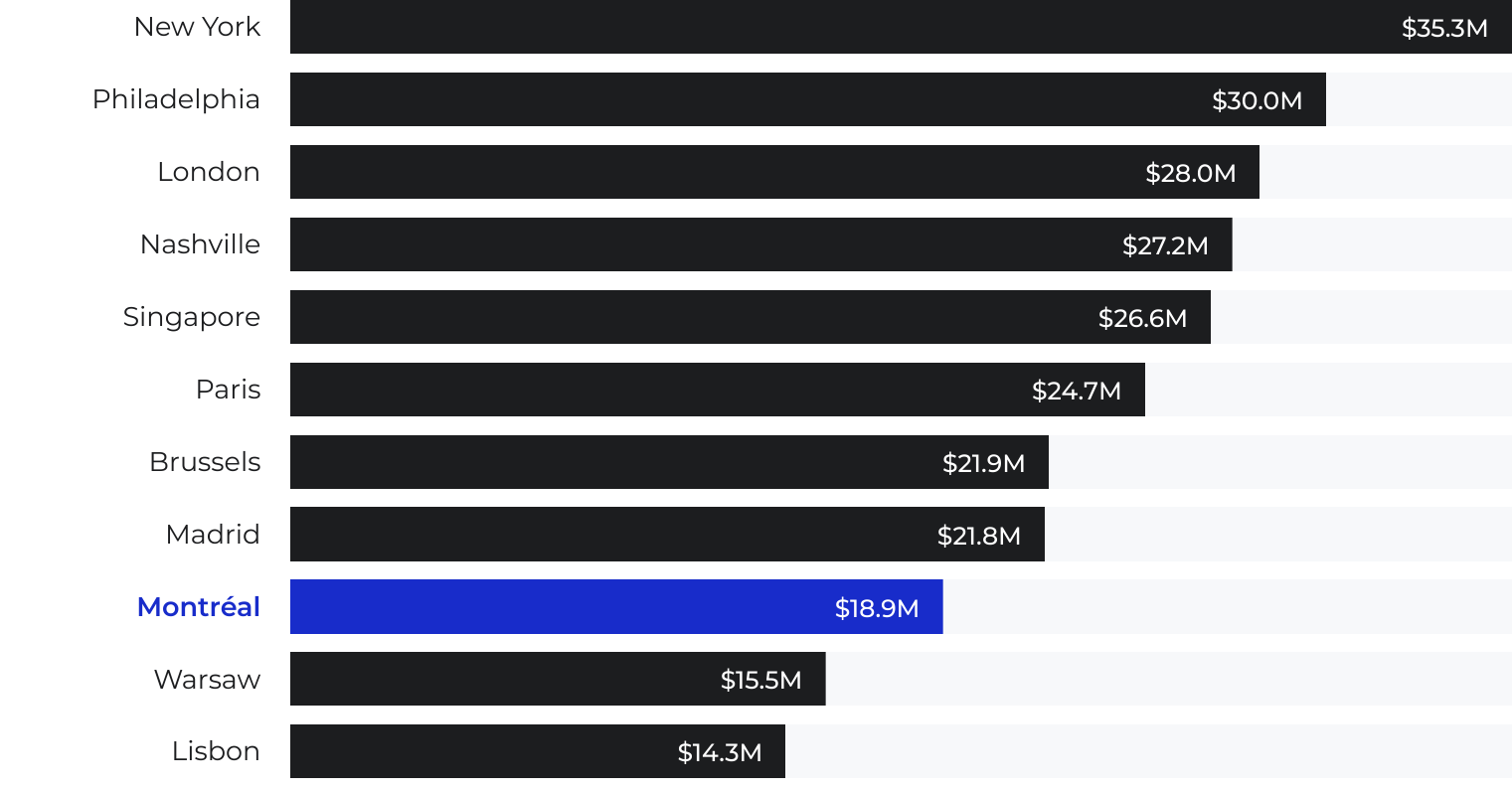
Source: The Boyd Company, United States 2026. Based on a model of 150 FTEs (full-time equivalents) in financial sector support services, in 30,000 square feet of Class B office space. US dollars = CA$1.39; €0.86; £0.76; PLN 3.70; SGD 1.28.
This competitiveness rests on several structural factors, notably labour costs, employment-related charges and real estate costs.
The main source of savings comes from payroll, which represents only 56% of New York’s, falling from US$22,646,400 to US$12,589,200 for a comparable workforce.
Employee benefits are a second determining factor: employer contributions in Québec and Canada, estimated at 25% of salary, are lower than in the United States, estimated at 34%. In our model, these costs decrease from US$7,926,240 in New York to US$3,147,300 in Montréal, a 60% reduction.
Finally, real estate costs also contribute to this competitive advantage. As the following chart illustrates, the cost of leasing Class B office space in Montréal is roughly half that of New York and one third that of London and Paris.
This combination allows organizations to benefit from a mature financial environment while significantly optimizing their operating costs.
Cost of leasing Class B office space
In US dollars per square foot, per year
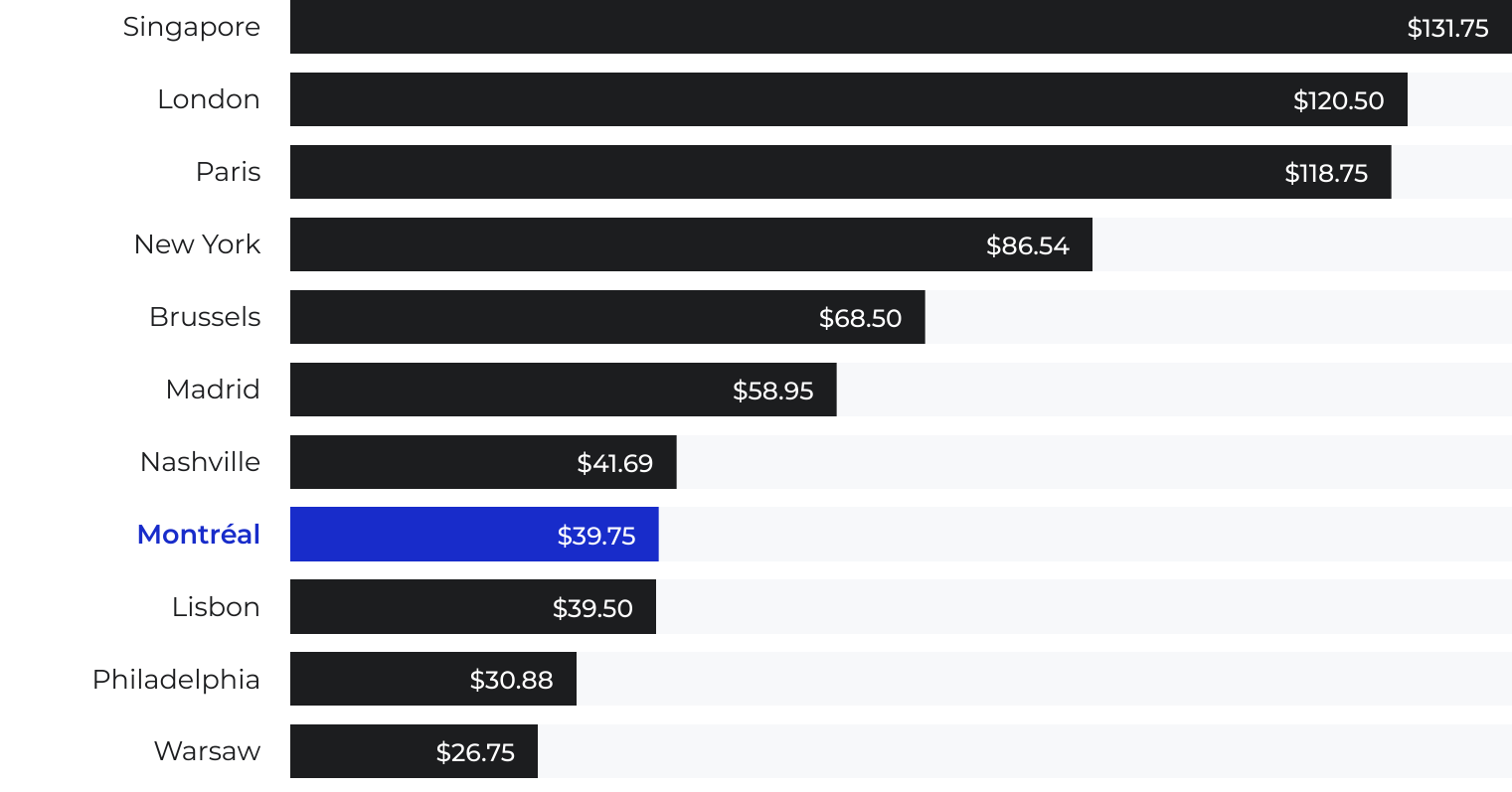
Source: The Boyd Company, United States 2026. US dollars = CA$1.39; €0.86; £0.76; PLN 3.70; SGD 1.28. Based on a Class B office space model.
The IFC program: an additional advantage
Added to this natural competitiveness is the International Financial Centre (IFC) program, which allows eligible companies to benefit from a tax credit of up to $18,000 per employee per year for certain international financial activities.
As the chart below illustrates, this incentive further strengthens Montréal’s competitive position. Factoring in the IFC measure, Montréal’s cost advantage becomes particularly clear when compared with Nashville, a US city frequently recognized as a low-cost location.
Operating cost savings from relocating out of New York
Reduction in total annual costs, 150-FTE model
|
From New York |
→ |
To · Savings
|
Source: The Boyd Company, United States 2026. Based on a model of 150 FTEs in financial sector support services, in 30,000 square feet of Class B office space. US dollars = CA$1.39.
The results show that Montréal generates nearly twice the savings of a comparable secondary US city such as Nashville. The IFC program alone contributes roughly 4 percentage points of additional savings, mainly through the reduction in net labour cost. Beyond the savings, Montréal also stands out for a more diversified and specialized financial ecosystem, giving companies access to higher value-added expertise and services.
To assess Montréal’s positioning in a European context, we compared the metropolis with Warsaw, often regarded as one of Europe’s leading hubs for financial services offshoring, given the large number of service centres established there in recent years.
Operating cost savings from relocating out of London
Reduction in total annual costs, 150-FTE model
|
From London |
→ |
To · Savings
|
Source: The Boyd Company, United States 2026. Based on a model of 150 FTEs in financial sector support services, in 30,000 square feet of Class B office space. US dollars = CA$1.39; €0.86; £0.76; PLN 3.70.
As the chart above shows, the cost savings observed in Montréal, when combined with the applicable IFC measures, become broadly comparable to those of Warsaw. The program narrows the gap to a marginal level, so that the savings achieved in the two cities are practically equivalent. The difference then lies in the overall value proposition.
While Warsaw primarily serves a European market coverage rationale, Montréal offers a comparable level of competitiveness while being located in the heart of the North American time zone. This strategic position makes it possible to serve the New York, Boston and Toronto markets efficiently, while facilitating follow-the-sun operating models for global financial organizations.
Added to this geographic advantage are a bilingual French-English business environment, a highly qualified workforce, and professional certifications that are recognized and comparable to those of the leading international financial centres. For European financial institutions with global operations, Montréal therefore constitutes a genuine gateway to the North American market, combining cost competitiveness, access to talent and proximity to the continent’s main decision-making centres. This is a key reason why several European financial institutions have chosen to establish or expand significant operations there in recent years.
Why is Montréal’s advantage sustainable?
Montréal’s competitive advantage rests above all on the depth and diversity of its talent pool, a factor that supports the durability of its competitiveness. In recent years, Québec’s financial sector has seen sustained growth without triggering wage overheating. According to Statistics Canada, employment in the finance and insurance sectors in Québec grew by 24.9% between February 2020 and February 2026, while maintaining labour costs that remain relatively lower than those observed in several other major financial centres.
Labour cost inflation in financial services, 2024-2026
Cumulative change, in percent
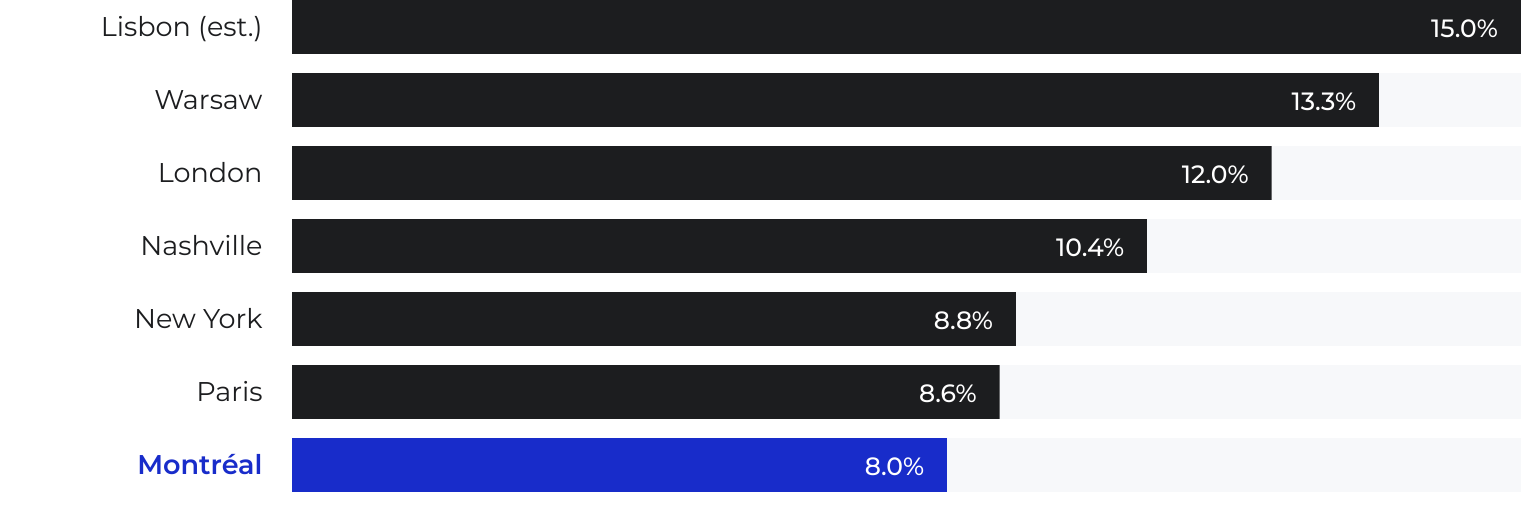
Source: The Boyd Company, United States 2023, 2024, 2026. Labour costs include base salary and benefits for a 150-FTE financial services centre, calculations in US$. The figure for Lisbon is an estimate.
This growth has been accompanied by the continued strengthening of the Montréal ecosystem, thanks to the combined presence of leading universities, major financial institutions, technology companies and a growing number of firms specializing in financial services.
As the following chart illustrates, the pool of employed professionals and of students enrolled in disciplines relevant to the financial industry compares favourably with that of well-established North American financial centres such as Boston and Chicago. This critical mass of talent gives companies sustainable access to a qualified and specialized workforce.
Talent pool: business and technology graduates relative to the size of the financial industry
Horizontal axis: total employment in finance and insurance (2024). Vertical axis: bachelor’s and master’s degrees in business, computer science and mathematics (2023-2024).
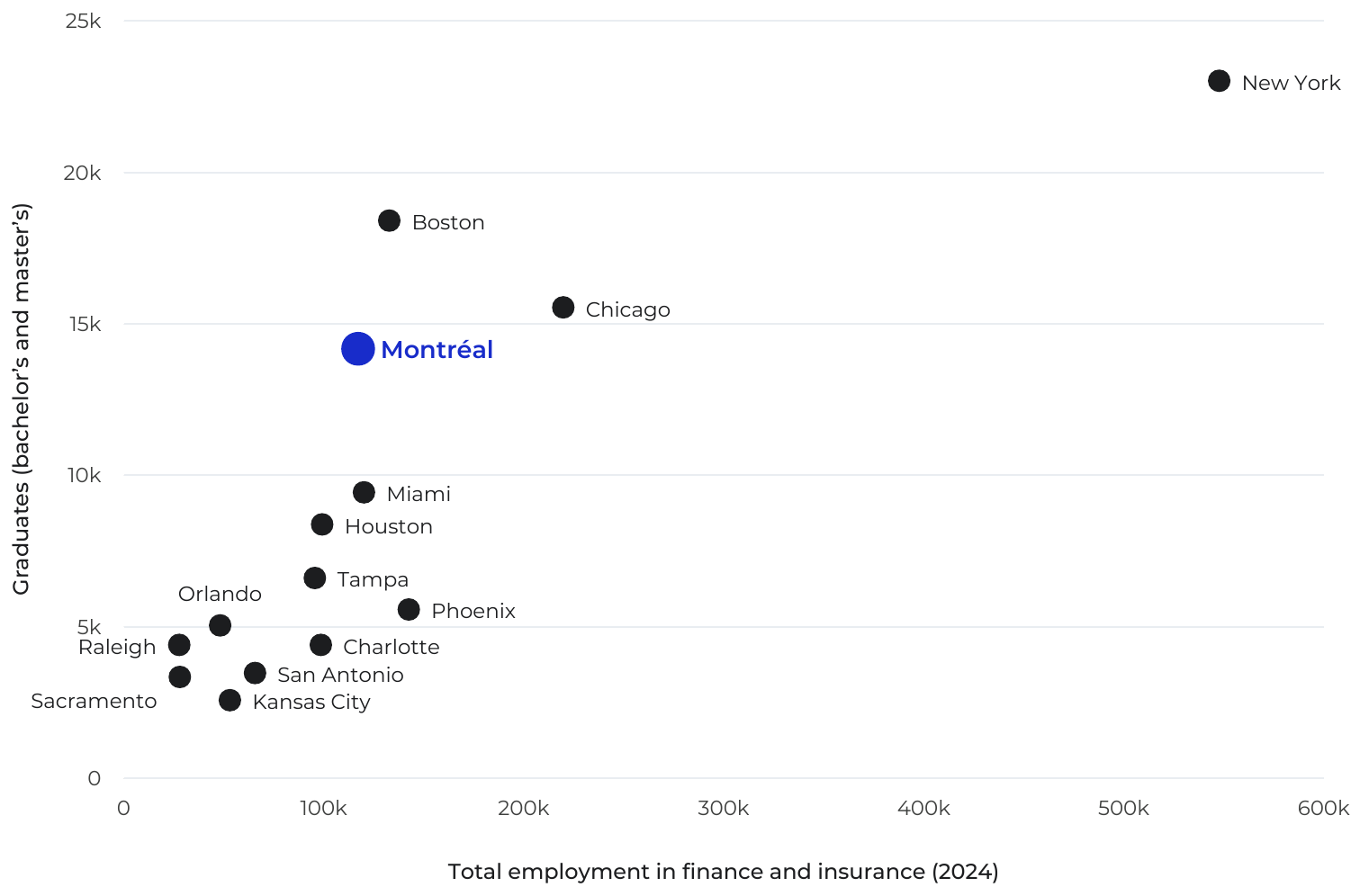
Sources: U.S. Department of Education, National Center for Education Statistics (May 2024); Ministère de l’Éducation du Québec; Statistics Canada and the U.S. Bureau of Labor Statistics — total employment in the finance and insurance industry (NAICS 52) over total metro area employment.
More importantly, the scale of this pool makes it possible to envisage the creation of several thousand additional jobs in the financial industry without exerting excessive pressure on wages. This absorption capacity is a strategic advantage for companies seeking to support long-term growth in a stable and competitive environment. As a result, the cost advantage Montréal enjoys today appears not only real, but also sustainable.
A distinctive position among the major financial centres
The Boyd study (2026) confirms Montréal’s distinctive position among the major international financial centres. The finding is unambiguous: among established financial centres, few cities manage to combine access to specialized talent, a mature financial ecosystem, recognized expertise in innovation and sustainable finance, direct proximity to the main North American markets, and such a competitive cost structure.
The centres that rival Montréal in terms of market depth, ecosystem maturity and value added — notably New York, London and Boston — generally show operating costs one and a half to two times higher.
Montréal thus stands out as one of the few jurisdictions to offer, simultaneously, competitive costs, a pool of more than 120,000 finance and insurance professionals, one of the largest concentrations of university students in North America, Canada’s leading fintech ecosystem, globally recognized expertise in sustainable finance, and direct access to the New York, Boston and Toronto markets, all in the same time zone.
For institutions seeking to increase operational efficiency without compromising access to talent, innovation and markets, Montréal today presents a value proposition that is hard to match in North America.
Morgan Stanley, BNP Paribas, Société Générale and Crédit Agricole have made that choice and account for several thousand jobs in Montréal today. The question is no longer whether Montréal is competitive, but when to take advantage of it. And each new establishment not only strengthens the Montréal financial ecosystem, but also contributes to the creation of specialized jobs, the attraction of international talent and the economic prosperity of Québec as a whole.
Finance Montréal’s role
- Support in building the business case and identifying eligible IFC activities
- Support for internal presentations to the various stakeholders
- Introduction to the operational ecosystem (recruiters, universities, professionals)
- Sharing of best practices with institutions already established in Montréal
Take action
Contact the IFC team to explore eligibility and build the business case.
About the study. The Boyd Company is an independent US consulting firm recognized for supporting the location decisions of large organizations such as Visa, Dell and JPMorgan Chase. For this study, Boyd used a standardized model representing a financial operation involving 150 employees in 30,000 square feet of Class B office space. The analysis takes into account labour costs, employee benefits, real estate, electricity, certain taxes and corporate travel expenses. All results are presented in US dollars to ensure comparability across jurisdictions.



.png)